What Is a Sanatayn Course? Meaning & Subjects
A Sanatayn course is a two-year Islamic studies foundation. Learn its meaning, common subjects, how it differs from Alimiyyah, and what to check before enrolling.
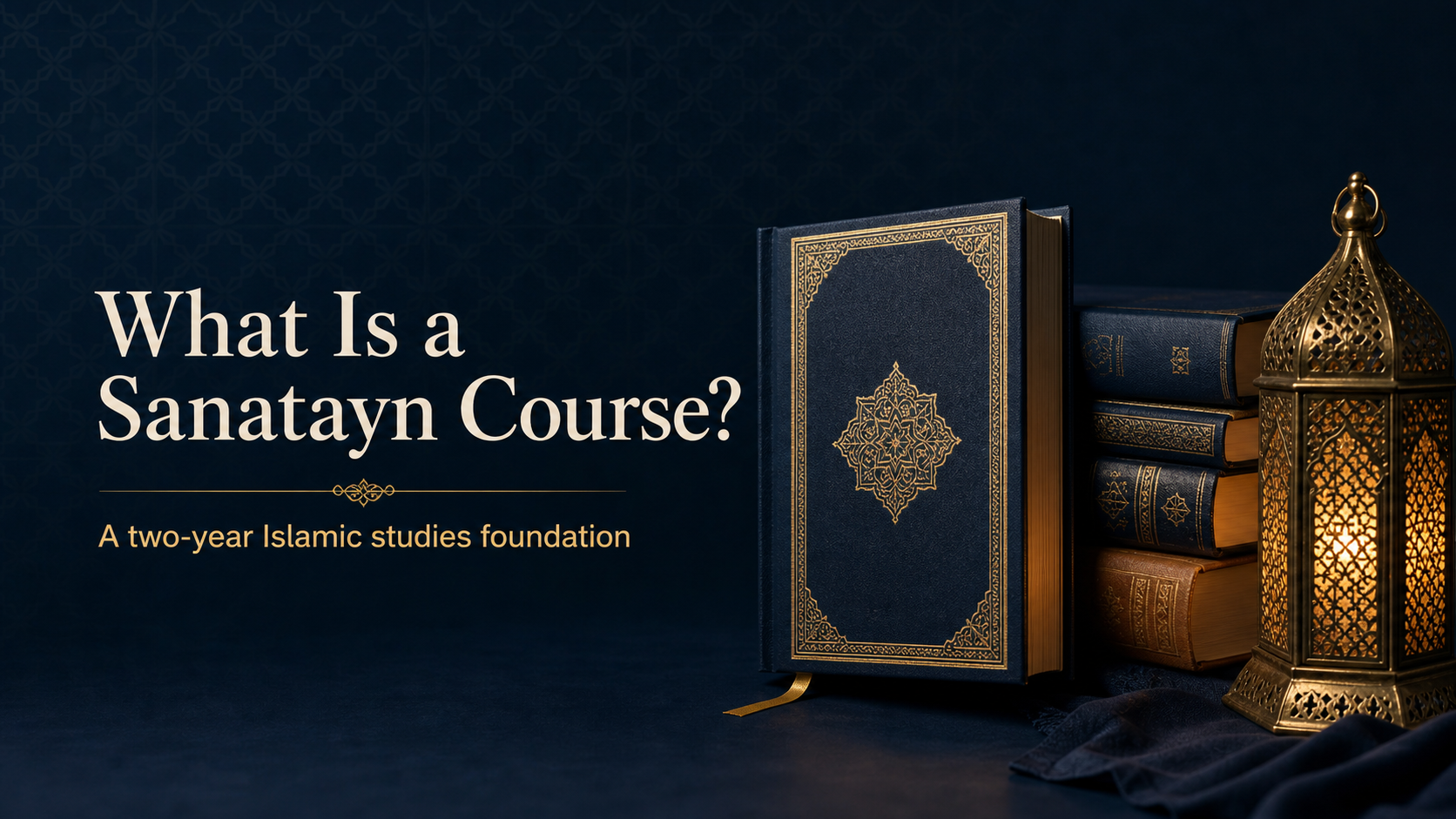
A Sanatayn course is a structured two-year foundation programme in Islamic studies. It normally introduces several core Islamic sciences—such as Qurʾān and Tajweed, Fiqh, ʿAqīdah, Hadith, Seerah, Tafsīr and Arabic—through a regular part-time timetable.
The important word is foundation. Sanatayn gives students an organised route into Islamic learning without requiring them to begin with a full multi-year ʿĀlimiyyah programme. However, there is no single national Sanatayn syllabus, so the subjects, depth, entry requirements and qualification can differ considerably between institutes.
Table of contents
- Quick summary
- What does Sanatayn mean?
- What is taught in a Sanatayn course?
- Is Sanatayn the same as Alimiyyah?
- Who is a Sanatayn course for?
- Online or in person?
- How much time does Sanatayn require?
- How to choose a good Sanatayn course
- Ocean of Islam’s Sanatayn courses
- Frequently asked questions
Quick summary
| Meaning | Sanatayn means “two years” in Arabic |
| Course type | A structured, two-year foundation in Islamic studies |
| Common subjects | Qurʾān, Tajweed, Fiqh, ʿAqīdah, Hadith, Seerah, Tafsīr and Arabic |
| Typical format | Part-time, with live weekly classes and study between sessions |
| Prior knowledge | Often beginner-friendly, but requirements vary by provider |
| Outcome | A broad foundation and, at some institutes, a certificate of completion |
| Next step | Standalone learning or progression to more advanced Islamic study |
What does Sanatayn mean?
Sanatayn (سَنَتَيْن) comes from the Arabic word sanah (سَنَة), meaning “year”. In course names, Sanatayn is understood to mean two years. With the definite article, you may see it written as al-Sanatayn (السَّنَتَيْن), meaning “the two years”.
English transliteration is not completely standardised. The same course may be written as:
- Sanatayn
- Sanatain
- Sanatayn programme
- Two-year Islamic studies course
- Two-year Islamic studies foundation
The spelling does not normally indicate a different kind of course. Sanatayn and Sanatain are two English renderings of the same Arabic term.
Why do institutes use an Arabic name?
The name describes the length rather than a single universal curriculum. In the UK, many mosques, madrasahs and Islamic institutes use Sanatayn for a part-time programme that gathers essential subjects into a coherent two-year course.
That also explains why two programmes with the same name may look quite different. One may emphasise Arabic language, while another may give more weekly time to Qurʾān recitation, Fiqh or spiritual development.
What is taught in a Sanatayn course?
Most Sanatayn courses aim to give students a connected introduction to the main Islamic sciences. A typical curriculum may include the following:
| Subject | What students commonly learn |
|---|---|
| Qurʾān and Tajweed | Accurate recitation, pronunciation, key Tajweed rules and selected memorisation |
| Fiqh | Practical rulings for purification, prayer, fasting and everyday Muslim life |
| ʿAqīdah | The foundations of Islamic belief and greater clarity about what Muslims believe |
| Hadith | Selected Prophetic narrations, their meanings and application to character and conduct |
| Seerah | The life of the Prophet Muhammad ﷺ studied in sequence, with practical lessons |
| Tafsīr | The meaning and themes of selected Qurʾānic passages or sūrahs |
| Arabic | Introductory grammar, vocabulary and sentence structure for engaging with Islamic texts |
| Tarbiyah or Tazkiyah | Spiritual growth, manners, sincerity and turning knowledge into consistent practice |
Not every Sanatayn course includes every subject as a separately timetabled class. Some combine Qurʾān with Tafsīr, Hadith with Adab, or ʿAqīdah with Tarbiyah. The course page should make that structure clear.
What should a student gain after two years?
A well-designed programme should produce more than familiarity with Islamic terminology. A student should leave with:
- A more ordered understanding of the Islamic sciences
- Greater confidence in worship and everyday religious practice
- Improved Qurʾān recitation where Tajweed is included
- A framework for distinguishing subjects such as Fiqh, Hadith and ʿAqīdah
- Study habits that support continued learning
- A clear sense of what to study next
The depth of each outcome depends on teaching hours, assessment and the starting level. Two years can create a meaningful foundation, but it cannot cover every Islamic science exhaustively.
Is Sanatayn the same as Alimiyyah?
Sanatayn is not automatically the same as a full ʿĀlimiyyah course.
A full ʿĀlimiyyah programme is normally longer and studies Arabic and the classical Islamic sciences in substantially greater depth. A Sanatayn programme is usually one of three things:
- A standalone two-year Islamic studies foundation
- An abridged introduction to subjects found in a longer ʿĀlimiyyah curriculum
- The first or foundation stage of a particular institute’s longer programme
Providers use the label differently. A course should only be described as a route into a particular ʿĀlimiyyah programme if the institute has made that progression clear.
Does a Sanatayn certificate make someone an ʿĀlim or ʿĀlimah?
No. Completing a two-year foundation and receiving a certificate is a valuable achievement, but it should not be confused with graduating from a full scholarly programme. A responsible course provider will state exactly what its certificate recognises and will not leave students with an inflated impression of the qualification.
For many students, that is not a disadvantage. They want dependable knowledge for their worship, family and personal development, or a manageable first step before deciding whether to pursue longer study.
Who is a Sanatayn course for?
A Sanatayn course may suit:
- Adults who want structured Islamic education alongside work or family life
- Parents and carers who need a predictable part-time timetable
- University students or older teenagers ready for sustained study
- Muslims who attended informal classes but want to organise their knowledge
- Beginners looking for a guided route through several subjects
- Students considering advanced Islamic study who want to test their capacity for long-term learning
It may be less suitable for someone who can only attend occasionally. The subjects build across terms, so regular attendance and revision matter.
Is Sanatayn suitable for beginners?
Many programmes are designed for beginners, but “beginner” does not mean “no commitment required”. A provider may still expect basic Qurʾān reading, regular attendance, homework or assessments.
Check the stated prerequisites rather than assuming. If the page is unclear, ask whether you need to:
- Read Arabic script or the Qurʾān
- Have studied Tajweed previously
- Know any Arabic grammar
- Follow a particular school of Fiqh
- Sit an entrance assessment
Can sisters study Sanatayn online?
Yes. Live online Sanatayn courses can make sustained study accessible to sisters across the UK and overseas, particularly where travel, childcare, work or a lack of suitable local provision would otherwise be a barrier.
The quality of an online programme depends on more than using Zoom. Look for live interaction, clear safeguarding and privacy arrangements, organised resources, a reliable Student Portal or learning system, teacher feedback and a timetable that encourages active participation.
Online or in person?
Neither format is automatically better. The right choice is the one that gives you strong teaching and allows you to attend consistently.
Live online Sanatayn
Online study can offer:
- Access from anywhere without travel
- A wider choice of teachers and schedules
- Easier participation around work and family responsibilities
- Course materials kept together digitally
It also requires a reliable internet connection, a suitable device, a private study space and the discipline to treat online lessons like a real classroom.
In-person Sanatayn
In-person study can offer:
- Face-to-face contact with teachers and classmates
- A physical environment dedicated to learning
- Fewer digital distractions
Travel time, location and fixed local schedules may make it harder to sustain for two full years. The best format is the one you can realistically continue when life becomes busy.
How much time does Sanatayn require?
The classroom timetable is only part of the commitment. Depending on the programme, students may need time for:
- Live lessons each week
- Qurʾān practice or Arabic exercises
- Reading and revision
- Homework or assignments
- Preparing for termly assessments
- Catching up promptly after an unavoidable absence
Before enrolling, put the full timetable into your calendar and include travel or setup time, private revision and existing family or work commitments.
Weekday or weekend?
A weekend course often works well for students in school, university or full-time employment. A weekday morning course may suit adult sisters, homemakers, mothers, university students, shift workers or those working part-time.
Do not choose only by comparing the number of teaching hours. A slightly lighter timetable attended consistently will normally serve you better than a more intensive course you regularly miss.
How to choose a good Sanatayn course
The word Sanatayn tells you the duration. It does not, by itself, tell you the quality or suitability of the programme. Ask these questions before paying:
1. Is the full curriculum visible?
Look for named subjects, Year 1 and Year 2 progression, books where relevant, and clear learning outcomes. A long list of subject names without an indication of depth is less useful.
2. Who teaches the course?
The provider should explain the teachers’ relevant qualifications and experience. For a sisters-only programme, confirm whether the live teachers are women and how privacy is protected.
3. Is teaching live, recorded or self-paced?
These are different learning experiences. If participation, recitation correction and questions matter to you, confirm that teaching is live and interactive. Ask what support exists if recordings are not distributed.
4. How are students assessed?
Assessments can show whether knowledge has been understood and retained. Ask about written tests, oral Qurʾān assessment, assignments, attendance requirements and feedback.
5. What does the certificate mean?
Check whether it is a certificate of attendance or completion, which requirements must be met, and whether the programme has a stated progression route. Avoid assuming that a two-year certificate is equivalent to a full ʿĀlimiyyah qualification.
6. What is the total cost?
Compare the full annual or two-year cost, not only the monthly figure. Ask whether books, registration, examinations or Student Portal access cost extra and read the cancellation terms.
7. Can you sustain the timetable?
The most impressive curriculum will not help if its schedule repeatedly clashes with your responsibilities. Choose the cohort you can attend punctually, week after week.
Ocean of Islam’s Sanatayn courses
Ocean of Islam offers a Sanatayn course for brothers in East London and online, alongside two live online routes for sisters.
Sanatayn for Brothers — London and Online
The Sanatayn course for brothers in London and online welcomes brothers aged 16 and above. Students can attend Monday evenings at SAMA Centre in Bow, East London, and Wednesday evenings online, or join both weekly sessions live online.
The two-year course covers Qurʾān, Tajweed and Tafsīr, Arabic through the Qurʾān, Fiqh of Worship, Hadith, Seerah, ʿAqīdah and spiritual development. It begins in October 2026 and includes recordings and Student Portal access.
Sanatayn courses for sisters
Ocean of Islam offers two live online Sanatayn courses for sisters, both beginning in September 2026, in shāʾ Allāh.
Sanatayn for Sisters — Weekend
The Weekend Sanatayn course for sisters welcomes students aged 14 and above. Classes run live on Saturday and Sunday mornings from 10:00 to 12:30 UK time.
Across two years, students build a foundation in Qurʾān and Tajweed, Arabic Grammar, Ḥanafī Fiqh, Hadith and Seerah. The weekend route is well suited to sisters balancing study with school, university or weekday work.
Sanatayn for Sisters — Weekday
The Weekday Sanatayn course for sisters is an adult cohort for sisters aged 18 and above. Classes run live on Monday, Tuesday and Wednesday mornings from 10:00 to 12:00 UK time.
Its curriculum covers Qurʾān, Tajweed and selected Tafsīr, Arabic Grammar, Ḥanafī Fiqh, ʿAqīdah and Tarbiyah, Hadith and Adab, and Sīrah and Islamic History.
| Weekend cohort | Weekday cohort | |
|---|---|---|
| Age | Sisters 14+ | Sisters 18+ |
| Days | Saturday and Sunday | Monday to Wednesday |
| Time | 10:00–12:30 UK | 10:00–12:00 UK |
| Live teaching | 5 hours per week | 6 hours per week |
| Format | Live online | Live online |
| Start | September 2026 | September 2026 |
Frequently asked questions
What does Sanatayn mean in English?
Sanatayn means “two years”. The name refers to the length of the programme rather than a single standard syllabus.
Is it Sanatayn or Sanatain?
Both spellings are used in English. They are different transliterations of the same Arabic term and normally describe the same type of two-year course.
What is the Sanatayn sisters course?
A Sanatayn sisters course is a two-year Islamic studies programme delivered in a women-only learning environment. The exact subjects and entry age depend on the institute. Ocean of Islam offers separate weekday and weekend sisters-only cohorts taught live online by qualified female teachers.
How long is a Sanatayn course?
Two years. Most providers organise those years into academic terms with weekly classes, breaks, revision and assessment.
Is Sanatayn a degree?
No. Sanatayn is an institute-based Islamic studies programme, not a UK university degree. Any certificate or progression arrangement should be understood according to the specific provider’s published information.
Is Sanatayn a full Alimiyyah qualification?
Usually not. It is commonly a foundation, an abridged introduction or the first stage of a longer pathway. A full ʿĀlimiyyah programme normally continues for several more years and studies Arabic and classical texts in greater depth.
Do I need to know Arabic before starting?
Requirements vary. Many courses teach introductory Arabic and do not expect previous grammar study, but some require students to read Arabic script or the Qurʾān at a basic level.
Can I study a Sanatayn course while working?
Yes, if the live timetable and private study load fit your routine. Part-time evening, weekday and weekend formats are common. Review the full weekly commitment before enrolling.
What can I study after Sanatayn?
Depending on your goals and the provider’s pathway, you might continue to advanced Arabic, Qurʾān, Fiqh, Hadith or a longer ʿĀlimiyyah programme. Sanatayn can also be completed as a valuable standalone foundation for personal religious learning.
The best Sanatayn course is one you can complete well
Course names matter less than clear teaching, a sound curriculum and sustained attendance. Compare what is taught, who teaches it, how learning is assessed and whether the timetable genuinely fits your life.
If you are looking specifically for a private online learning environment for women, explore all Ocean of Islam courses for sisters or compare the weekday and weekend Sanatayn cohorts.